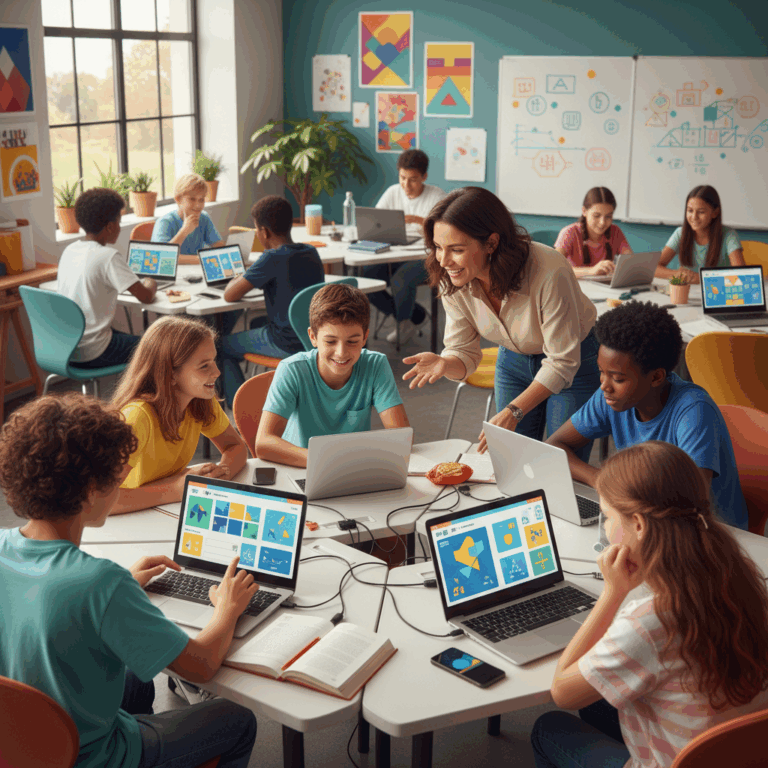
Game-based learning in practice
The last few months have been very exciting for all project partners involved in InterGames. We finally got to test our 20 educational sequences, which had been developed and translated into all seven project languages, with students.
Today, I am writing to you from Austria, where a total of 128 students aged 15 and above played and tested three online games and the accompanying teaching materials: Plasticity, Phone Story and Climate Trail. In Austria, we from the InterGames team took charge of the lessons ourselves – in other countries, the team only provided support for the teachers, and in yet other project countries, the teachers carried out the testing completely independently.
But we were curious about the process and the feedback and simply wanted to know whether what we had come up with actually worked! And let’s say this much in advance: it worked wonderfully!
From the outset, our educational sequences were designed in such a way that teachers had to familiarise themselves thoroughly with the didactic integration and technical implementation of the specific game in advance – unlike in other teaching sequences, even experienced teachers had to invest much more time in preparation. This was confirmed once again during testing!
For example, the game ‘Plasticity’ only runs on the ‘Steam’ gaming platform, where you have to create a free account in advance and then download the game for free before you can play it. However, on PCs in schools, only administrators are allowed to download and install software. This meant that pupils were asked in advance to bring their own laptops from home and, if possible, to create a Steam account. Those who were unable to do so were provided with a laptop by the school on which the school administrator had already pre-installed everything – this also meant that communication, networking and concrete work had to be done in advance and teachers had to work together. This was a small challenge in itself in the hectic everyday routine – but it was mastered brilliantly in Austria! 😊
Climate Trail did not require a gaming platform or an account, but the teachers and administrators at the schools had to install the game on the school PCs in advance.
And Phone Story was ultimately the simplest and most accessible in technical terms, as it only required downloading a free app onto the students’ mobile phones – in our case, all students had a smartphone and had no problems getting the game to run.
All the problem areas addressed – climate change, plastic waste and the sometimes-devastating impact of the mobile phone production and raw materials chain – were linked to the secondary curriculums. The slightly different approach to knowledge transfer and the concrete experience of the problems in the subject areas was fun for the students and a nice change. Working on solutions was stimulating and very creative.
Here are two quotes from students who took part in the Climate Trail test rounds:
“The computer game Climate Trail showed me that we need to help the Earth before it’s too late. We also need to stick together as a group or as humans, because if one person dies, several die, and eventually everyone dies. You have to share your resources before you run out and save where you can. We should also recycle more and see how we can save our Earth as quickly as possible. Without action, humanity will end up like in the game, and now is the last chance to prevent this. Many people still don’t realise the seriousness of the situation and continue to order from fast fashion brands like SHEIN or TEMU.‘
’The computer game “Climate Trail” showed me how long such a journey takes and, above all, how complex it is. You need huge amounts of food and drink. Many people are in the same situation in real life. Many refugees go through the same journey, starving or enduring extreme weather conditions.‘
Overall, we are very pleased with the successful materials and hope that they will make it easier for many teachers to get started with game-based learning.
You can find out more about the finished materials in our next blog post and on our website under ’Project Results”.
Stay tuned and have fun!